Research
Active Adaptive Matter
Living organisms, such as bacteria and eukaryotes, exhibit rich behaviours and display different phenotypes, i.e., different observable characteristics such as physical properties, depending on their direct surroundings. One important source of variability in the immediate environment of living cells is the presence of deformable, nutrient-rich networks. Examples of such networks include vasculature in healthy and malignant tissue, as well as bacterial biofilms interspersed with water channels. These networks not only vary spatially and physically constrain the populations of cells, but also affect these populations through nutrient availability variations caused by diffusion limits.
Moreover, living cells are active, i.e., convert energy into mechanical work. Hence, they exhibit collective dynamics that can affect network architecture, e.g., due to pressure buildup, resulting in temporal variations. When conditions remain stable, whether nutrient-rich or nutrient-poor, single populations adapted to those specific conditions are selected. In contrast, environments that fluctuate over time encourage the adaptation and coexistence of phenotypes with diverse mechanical and metabolic traits, even in the absence of genetic differences. Such phenotypic heterogeneities are a well-known, but extremely challenging, culprit in the development of drug resistance in both tumours and bacteria8. Thus, understanding reciprocal feedback between dynamic sources of nutrients and activity and cells is essential for understanding the spatio-temporal dynamics of tissues in vivo and of biofilms. It will also guide us to identify strategies for preventing the emergence of resistant phenotypes.
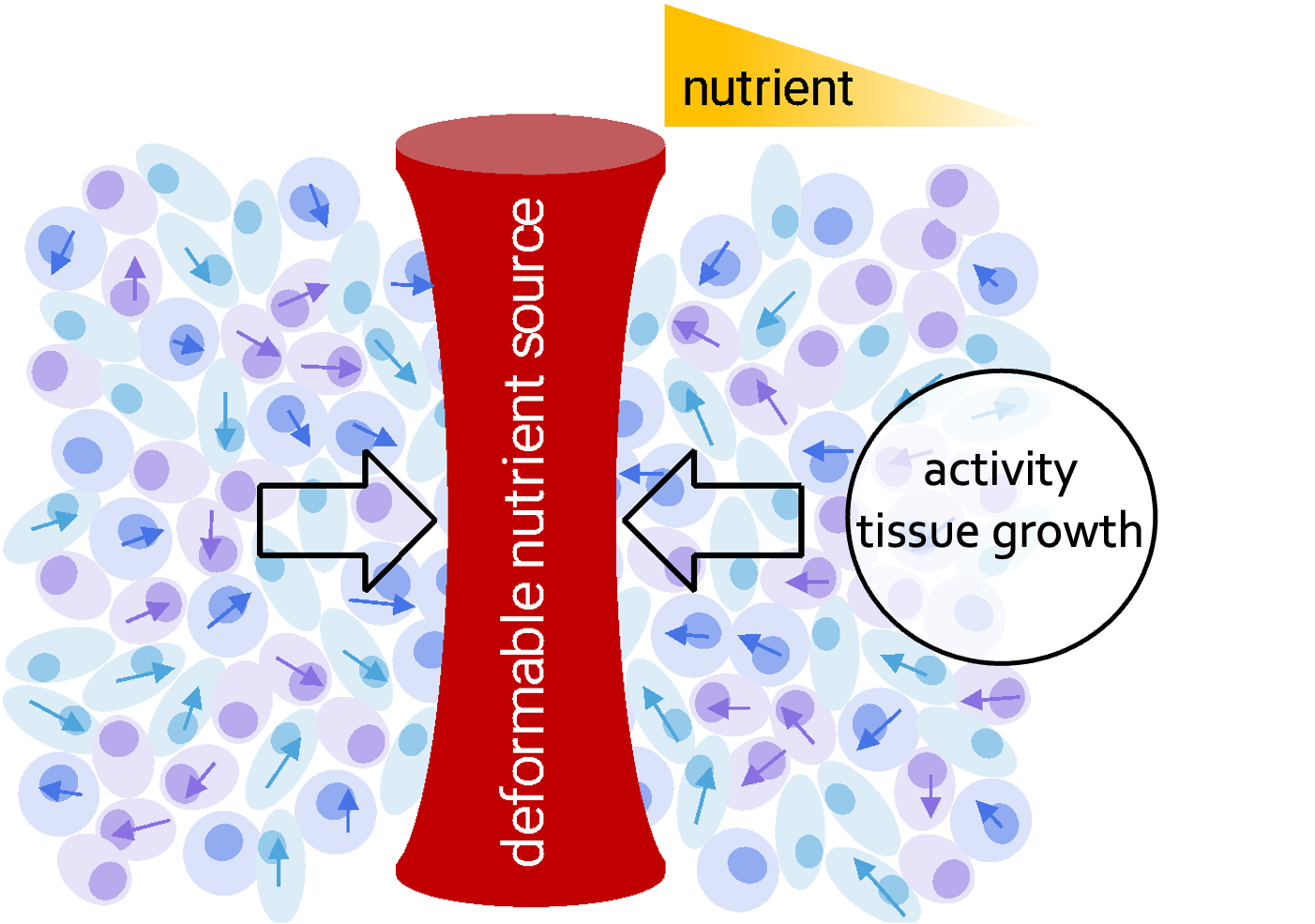
Replicating such systems experimentally is notoriously difficult due to the nonlinearity of interactions across different levels of tissue organisation (environment–cells–nutrient networks). Besides, isolating the impact of each element in experiments is extremely challenging. Therefore, the